Showing posts with label Sightings. Show all posts

Monday, 29 February 2016

February wrap-up


With March a few days away I've put together a quick re-cap of the birding I managed in the latter half of February.

I spent the 19th-21st on Malta's sister island of Gozo on a rope access training course. This entailed sitting on a clifftop looking South over the sea for long periods of time which left ample opportunity for birding. House Martins passed in small groups and the first Barn Swallows of the year were seen. Spectacled Warblers churred from the garrigue below us and a male Blue Rock Thrush sang from a disused hunting emplacement.


The team. Gozo. February, 2016

Visiting Salina in the early morning on Wednesday 24th revealed 2 Little Egrets in the pans. Their provenance is unknown due to a nearby free-flying artificial population however. Alongside the still-large Black-headed Gull roost, the 5 Little Stints were still present as were the 3 Common Sandpipers. James Symonds who had arrived earlier also recorded a Goldcrest, Grey Wagtail and Green Sandpiper (a species I have yet to catch up with on Malta). The mix of olives and conifers in Kennedy Park held c40 Black Redstarts, Meadow Pipits, Chiffchaffs, White Wagtails and the usual resident species.


Little Egret Egretta garzetta. Salina. February, 2016


While watching Tree Sparrows in a reliable spot James found a male Subablpine Warbler low in the scrub behind us. I only managed poor views of it noting it's relatively small size, the blue-grey back and head unlike the bicoloured upperparts of the ever-present Sardinian Warbler, and a flash of white outer rectrices. James's good view of the head and breast confirmed an Eastern Subalpine Warbler, the expected species in Malta, and the first record for 2016. After much searching we could not re-find it and no definite calls were heard. The recent taxonomic changes to the Subalpine Warber complex are fascinating and I plan to write a little more about it in the near future.

Later that day while walking amongst the low trees at Rdum tal Madonna we flushed a Hoopoe, my first in Malta and always a fantastic bird to find.

Roll on March!


Thursday, 18 February 2016

The first signs of migration

The first stirs of Spring 

This week I moved to Qawra, at the eastern end of the St. Paul's Bay conurbation. The longer commute to work is balanced out by being much closer to Salina salt-pans, a site I wrote about in January. I visited twice this week, both in the morning and the evening.

Large numbers of Black-headed Gulls are still present, roosting on the raised banks of the pans. c650 were present on Tuesday 16th, with a handful of Mediterranean Gulls, Yellow-legged Gulls and a single Sandwich Tern.

The flock of Little Stints had risen to five with at least two Common Sandpipers still present. Two Kingfishers flew into the small patch of reeds and called.

Not much seemed to have changed on Thursday 18th when I noticed a flock of 16 House Martins circling overhead and heading North, a welcome early migrant to Malta. Single House Martins have been reported over the last couple of weeks and I had seen five over Simar Nature Reserve early the same day.

Chiffchaff numbers are fluctuating and enough new birds are being ringed at the reserves to show they are moving through the island, as must be the Meadow Pipits and other species.


Salina gull roost. February 2016
It's still early but I'm keen to see what the next few weeks will bring, a Great Spotted Cuckoo would do nicely!

Sunday, 7 February 2016

February arrives in Malta

A slow week for new species 

I have had a busy week conducting research on Yelkouan Shearwaters in the various cliff face colonies of Malta and Gozo. This has meant I have not had much time for birding but still managed some interesting sightings.

On Sunday, January 31st, I spent some time at the reserves at Ghadira and Foresta in the north of Malta. Ghadira was quiet with a single Common Sandpiper and the still-present Curlew being the only species of interest. However a short walk in Foresta produced my first Corn Bunting as well as three Song Thrush and a Blackbird. All of these songbirds are worth commenting on here in Malta, although common at home in the UK. Thrushes are targeted heavily by hunters and the Corn Bunting is suffering the same destruction of adequate farmland habitat as elsewhere.

On Wednesday 3rd I spent a couple of hours before work at Simar reserve in Xemxija. A male Firecrest feeding in the tops of the olive trees was a welcome surprise, a species I have not seen for a few years. Less tied to coniferous trees than the Goldcrest, both species can be seen here in Malta in winter in small numbers.

On Thursday 4th I was back at Ghadira and saw two newly-arrived Greater Flamingo. Uncommon but expected each year in small numbers, these two birds may have become separated from a larger flock during a storm on Wednesday night. Both second-year birds (hatched last year), their plumage is still mostly white, not the warm pink that adults attain. A Shelduck, at least the second individual presently on the island, was feeding nearby.


Greater Flamingo Phoenicopterus roseus. Ghadira, Malta. February 2016. This individual is paler than the one below with less brown on the coverts and remiges, indicating a more progressed moult.


This week I also saw my first Audouin's Gulls, although both times the views were sub-par with no photos to show for it. I noticed a 2cy bird circling around St. Paul's Bay on Monday from my balcony and an adult passed my perch on the cliffs at Rdum Tal-Madonna on Thursday. This is a species I am keen to study more closely and hope to photograph well in the upcoming months.

Lastly, today, Sunday 7th, I visited Simar briefly and saw a Water Rail. One bird was foraging furtively at the edge of the water, only showing for a few seconds. There have been Water Rails at both reserves all winter but until now have proven to be typically hard to see.

Today also marks my first month in Malta with 49 species seen so far.


Sunday, 24 January 2016

Salina salt pans: January 24th 2016


A new site and three new species

A report this morning of a Cattle Egret at Salina salt pans prompted me to hop on a bus and explore the area for the first time. Just 10 minutes from where I am based in St.Paul's Bay, the salt pans are overlooked by multi-story buildings on the outskirts of Qawra.


Salina salt pans looking east.


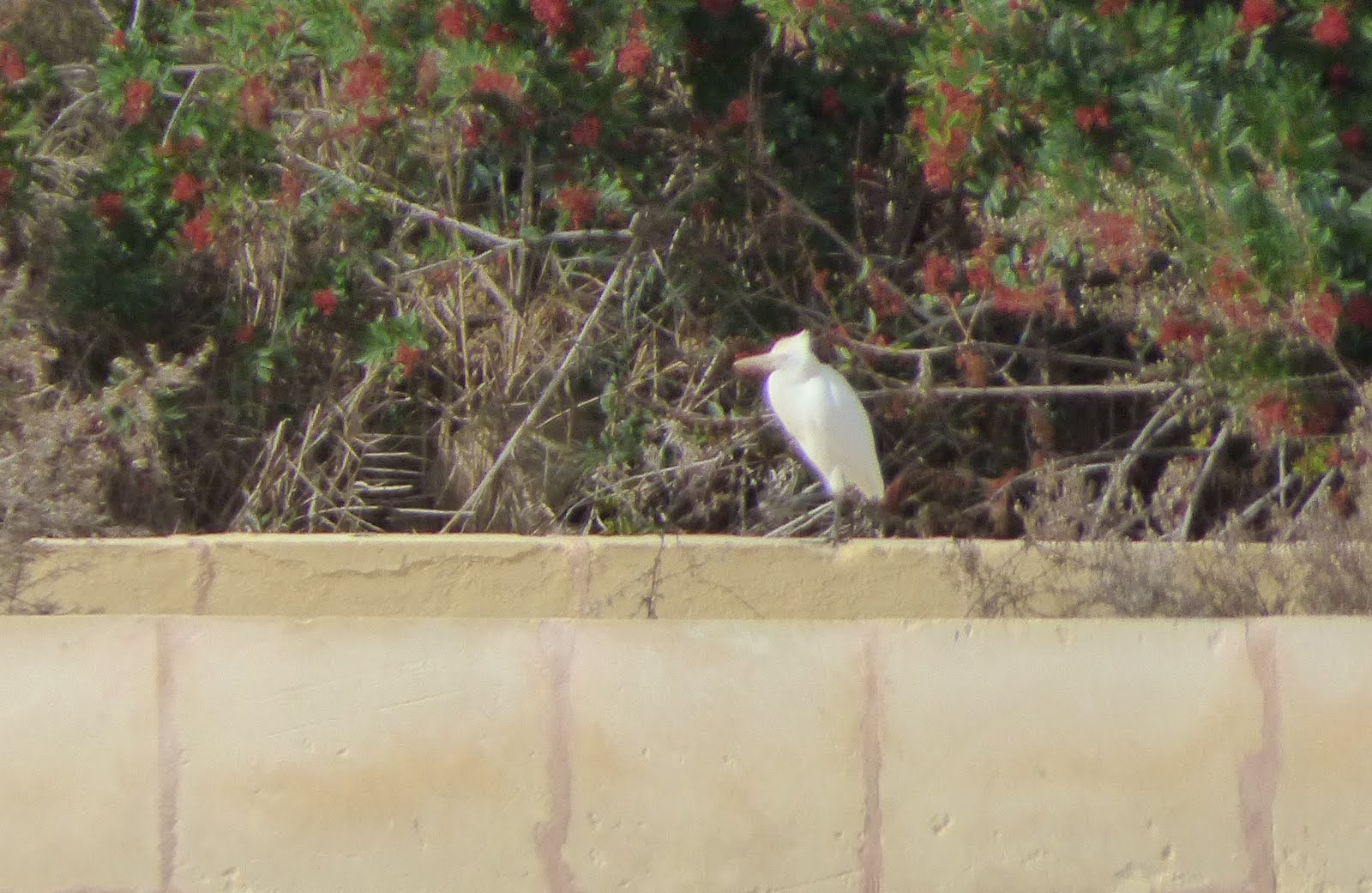
Some of the pans held water and it didn't take long to find the Cattle Egret. After a few minutes it flew off west, hopefully leaving Malta safely (or possibly just heading off to feed in the nearby fields). I have not yet seen the much more common Little Egret in Malta.


Cattle Egret Bubulcus ibis. January 2016.

A Shelduck feeding in one of the deeper pans was a nice addition. A few have been reported over the last two weeks from both of the reserves and passing offshore.


Common Shelduck Tadorna tadorna. January 2016


The westernmost pan had three Little Stint and one of three Common Sandpiper picking through the mud between rusty cans and semi-submerged plastic bags. 


Little Stint Calidris minuta. January 2016


Common Sandpiper Actitis hypoleucos. January 2016


Alongside the usual White Wagtails and Spanish Sparrows other birds of note included a large mixed flock of 470 Black-headed Gulls and 20 Mediterranean Gulls with a couple of Yellow-legged Gulls passing over. A scope would have been useful to scan the distant flock.


The end of the pans looking towards Qawra Point


Rdum Tal-Madonna: January 22nd 2016

Wind-chasers in the distance

A late afternoon visit to Rdum Tal-Madonna revealed a high count of 18 Black Redstarts, alongside Meadow Pipits and Western Stonechats in the Garrigue, and Chiffchaffs and Robins in the scrub.

A Golden Plover flew north calling, possibly an escapee as many of this species are held in captivity on Malta

A seawatch turned up the usual Yellow-legged Gulls and Sandwich Terns but the undoubted highlight were the Yelkouan Shearwaters that began to appear in small flocks after 17:00. Although at least 3km away, their size, distinctive flight and counter-shaded plumage were diagnostic.

Their name 'Yelkouan' derives from the Turkish 'wind-chaser', a suitable name for the species although the lack of wind on this occasion kept them from showing off their acrobatic abilities.


Moonrise over the Mediterranean

Tuesday, 19 January 2016

Small Larids of St.Paul's Bay

Worth a closer look

Strong winds over the weekend has led to large numbers of gulls sheltering in Maltese harbors. I have not yet had a chance to visit the larger gull roosts but St.Paul's Bay has small numbers early in the mornings. Today I took the opportunity to take some photos (in some very overcast conditions) of three members of the Laridae family roosting together.


Black-headed Gull Chroicocephalus ridibundus, Mediterranean Gull Larus melanocephalus and Sandwich Tern Sterna sandvicensis. Xemxija, Malta. January 2016


By far the most common gull at this time of year is the Black-headed Gull. A non-breeding visitor to Malta like the other two species in the photo, flocks of over 200 birds can be found in sheltered bays around the island. Referred to as a 'two-year' gull, the Black-headed Gull takes two years to reach adult plumage. A 1st-winter individual can be seen on the rightmost end of the metal beam, whilst the others are winter plumage adults with varying amounts of black (actually a chocolate brown) on their heads. The single Mediterranean Gull in the photo is the left-most bird on the same beam, again a 1st-winter individual, although this slightly larger species has three age classes. The Sandwich Tern, a winter plumage adult, is the back-centre bird. 


Mediterranean and Black-headed Gulls. Xemxija, Malta. January 2016.

This angle clearly shows the difference in structure between the two smaller gull species. The Mediterranean Gull on the left is longer legged and slightly larger than the Black-headed Gull next to it, with a less rounded head and a stouter bill. This group had individuals representing all the age classes of both species but an opportunity to photograph them decently did not arise. Notice the variation between the two 1s-winter Mediterranean Gulls due to moult timing.


Sunday, 20 December 2015

It's worth visiting the Warren


Create the habitat and the birds will do the rest

RSPB Broadwater Warren is my closest nature reserve here in Tunbridge Wells, East Sussex. The RSPB have managed the site since 2007 with the aim to create a variety of habitats including large areas of lowland heath, an ecosystem of which 80% has been lost since the 1800s. Essentially a large conifer plantation previously, 65 hectares of this monoculture have been cleared of pines so far with more planned. The area has been cleared in stages, the earliest of which are already carpeted with heather. Alongside this newly created heath are patches of broadleaf woodland, stands of pine, forest ponds and rough areas of bramble and gorse. These new habitats quickly attracted their specialist birds; it is a fine example of planned physical management increasing biodiversity.


(Western) Stonechat Saxicola rubicola. December 2015.

The highlights are the Woodlark and Nightjar, both of which have been present on the reserve in the spring and summer for 5+ years now, alongside Yellowhammer, Tree Pipit, Woodcock, Kingfisher, Grey Wagtail, Lesser Spotted Woodpecker and Stonechat amongst more common species. The excitement of hearing the first Woodlark song over the heath so close to home is memorable.

I have been working abroad for the majority of the last five years but whenever I am in the area I visit Broadwater Warren and see how it is progressing. I managed to visit four times throughout December this year and saw these Common Crossbill. Other interesting species I have recorded here include Firecrest in 2012 (the first for the reserve), a Redstart this spring and a Raven a week ago.     


Common Crossbill Loxia curvirostra. December 2015.

A report of the first Dartford Warbler for the reserve was made on November 5th, moving with a group of Stonechat, but has not been seen since. It is surely just a matter of time however until these charismatic birds settle at Broadwater Warren, yet another reason to visit this dynamic and constantly changing reserve in the High Weald.


Regenerating heath. December 2015.

Wednesday, 16 December 2015

Rye Harbour - 13/12/15


I spent three hours birding around the circular trail at Rye Harbour Nature Reserve on Sunday. Designated a SSSI, SPA and SAC due to its nationally important habitats including saltmarsh, fresh pools, brackish lagoons, reedbeds and coastal shingle, it always attracts good numbers of birds. Just an hour from Tunbridge Wells, I try and visit Rye Harbour at least once a year whenever I am in the UK. The website has recently been updated.

Although overcast and cold there were lots of birds on the lagoons including c1000 Golden Plover, c700 Lapwing, c300 Wigeon, and dozens of Oystercatcher, Shoveler, Gadwall and Teal. Alongside the odd Redshank, Grey Plover, Ringed Plover and Dunlin I picked out two Snipe.

The shingle beach produced a Skylark and a dozen Turnstone.

Although nothing too special materialised, the huge flock of Golden Plovers wheeling over the main pool was a spectacle, probably flushed by a raptor which I did not manage to locate.

Total count: 40 species

Common Snipe Gallinago gallinago. Eilat, September 2015. Nope, not a photo from the UK but more enjoyable than distant birds on an overcast day.